Source and Flow: The Historical Evolution and Cultural Accumulation of the Spring Festival
The history of the Spring Festival can be traced back to the seasonal sacrificial activities thousands of years ago. As early as the Shang Dynasty, the ancient Chinese had established the "Là Festival" and "Year-End Sacrifice" to pray for a good year and pay respect to heaven and ancestors. By the Han Dynasty, the Là Festival evolved into "Là Month," and the initial form of the New Year began to take shape; after the Eastern Han Dynasty, "Yuan Ri" became the official term for the beginning of the year, and the Spring Festival gradually became institutionalized, coinciding with the Lunar New Year.
By the Tang and Song Dynasties, the customs of the Spring Festival gradually became richer, with the festive period extending from the Là Month to the First Month, forming a complete festival system that includes dust sweeping, posting Spring Festival couplets, setting off firecrackers, dragon and lion dances, paying New Year visits, and the Lantern Festival, which continues to this day. During the Ming and Qing Dynasties, the Spring Festival became even more deeply rooted in folk society, becoming an indispensable important time node in the lives of urban and rural residents.
The evolution of the Spring Festival is not only a history of the development of a holiday but also a history of the integration and coexistence of Chinese culture and social structure. It records the rhythm of agricultural civilization and reflects the intertwining of Confucian family ethics, Daoist harmony between heaven and humanity, and Buddhist concepts of cause and effect, serving as a concentrated embodiment of the Chinese people's "cultural perspective on time."
Before the New Year: The Psychology and Symbolism in Preparation Rituals
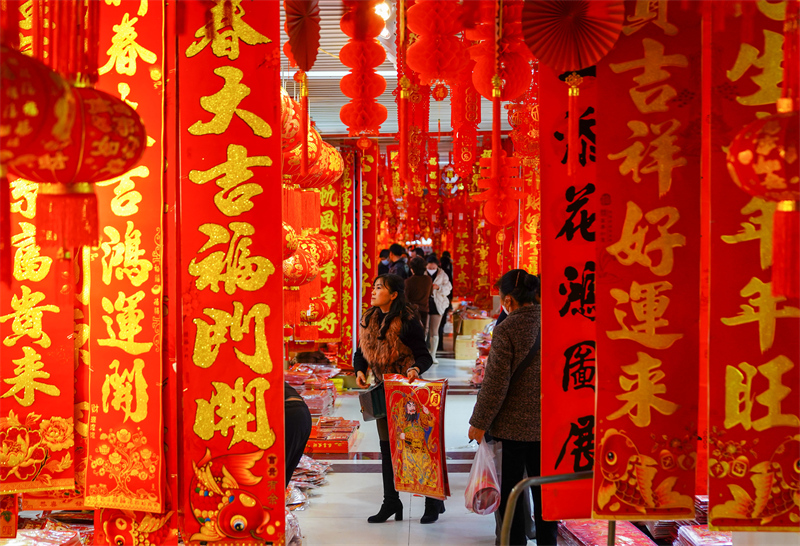
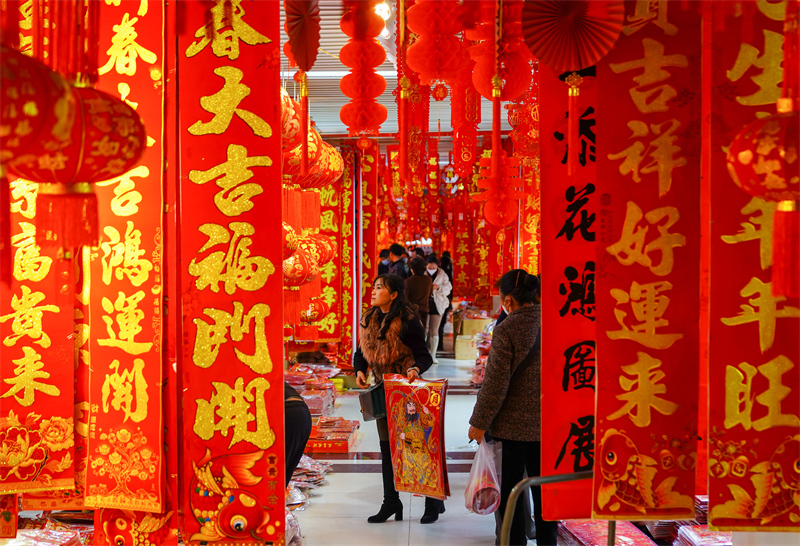
The sense of ritual for the Spring Festival quietly begins in the twelfth month of the lunar calendar. After the Laba Festival, people start to "prepare for the New Year": curing meat, steaming rice cakes, making lanterns, purchasing New Year goods, cutting window flowers, and cleaning. These seemingly trivial household tasks actually form an orderly system of pre-festival rituals.
"Cleaning" is not just about tidying up; it also symbolizes "removing the old and welcoming the new," signifying the removal of bad luck and the welcoming of good fortune. "Posting Spring Festival couplets" announces to the outside world that "the New Year is approaching" through auspicious phrases and color contrasts. The preparation of "New Year goods" is not merely about accumulating material items; it also reaffirms family relationships: who is responsible for buying meat, who makes dumplings, and who manages the kitchen, as household roles and divisions of labor are reinforced and negotiated amidst the busyness.
In addition, the pre-festival ritual of "sending off the Kitchen God" reflects the continuity of the relationship between humans and deities. Through actions such as burning incense to pray for blessings and sending off kitchen sweets, people hope that the Kitchen God will speak good words to the heavens, paving the way for good fortune in the coming year.
These preparatory activities are not just for a New Year's Eve dinner or a few days of holiday; they also help people psychologically transition from the "old year" to the "new year," forming a sense of continuity in collective memory and a mechanism for emotional renewal.
New Year's Eve: The Explosive Point of Family Rituals and Reunion Emotions
The climax of the Spring Festival is undoubtedly New Year's Eve. It is the most symbolic and emotionally dense moment of the year, and it is also the point that best reflects Chinese family culture.
The New Year's Eve dinner is the core ritual of the evening. Dishes vary by region, but the theme of "reunion" remains unchanged. In the north, dumplings are the main dish, symbolizing "the old year passing and the new year arriving"; in the south, there are rice cakes, eight-treasure rice, chicken, duck, fish, and meat, signifying "surplus year after year" and "rising step by step." The dishes are not only a sensory enjoyment but also carry the tasks of language, wishes, and cultural encoding.
After the meal, "staying up" begins. The whole family sits together, chatting, watching the Spring Festival Gala, and playing mahjong. This is not just a form of staying up late, but also a gesture of "guarding" and "accompanying," symbolizing the farewell to the old year and the welcoming of the new spring. This night is the closest moment between generations and the time when familial affection is most magnified.
There are also highly symbolic "red envelopes" and "lucky money." Elders give lucky money to juniors, wishing for their healthy growth; juniors serve tea to elders to express respect and gratitude. Behind this economic behavior lies a dual interpretation of ritual culture and blood relations.
New Year's Eve is a dividing line of time and a point of emotional concentration. It carries not only a farewell to the past but also a collective promise for the future.
The Lunar New Year: The Continuation of Festivals and the Reorganization of Social Order
After New Year's Eve, the festival does not end, but rather marks the beginning of another phase. The entire month of January, especially the first fifteen days, is an extension of Spring Festival customs and a concentrated display of community culture.
From the first to the fifth day of the new year is the time for "visiting relatives," where friends and family visit each other to exchange New Year greetings. This is both a practice of etiquette and a maintenance of social networks. Relationships, status, and generational hierarchy are confirmed and sorted through the repeated greetings of "Happy New Year," and the closeness or distance among people is quietly reordered during this round of visits. Different regions have different taboos and customs, such as not taking out the trash on the first day, returning to the maternal home on the second day, avoiding going out on the third day, welcoming deities on the fourth day, and sending away poverty on the fifth day. These taboos and arrangements not only reflect a symbolic control over time and behavior but also reveal people's psychological adjustment and cultural imagination regarding the transition of years and the fortunes of good and bad.
The Lantern Festival on the fifteenth day of the first month marks the end of the Spring Festival and serves as a turning point for the festival to "turn outward." Activities such as lantern displays, riddle guessing, lion dances, and stilt walking are not only the climax of festive entertainment but also a form of collective social expression. At this juncture, the Spring Festival transitions from the family to the community, from the private domain to the public sphere, completing an externalization of festive energy.
Throughout the Spring Festival, people establish or renew their relationships with the heavens, deities, ancestors, friends, and neighbors through dragon and lion dances, temple fairs, incense burning, and firecrackers, forming a condensed yet complete cycle of social interaction.
Symbolic Logic and Cultural Significance in New Year Customs
The reason why the Spring Festival remains ever-fresh lies in its vast system of symbols and symbolic language. These folk customs, seemingly lively and complex, actually form the intersection of folk beliefs, ethical order, and aesthetic taste.
For example, “The sound of firecrackers marks the end of the year,” where firecrackers are not only a source of entertainment but also symbolize the expulsion of evil and the welcoming of good fortune; “pasting the character for fortune upside down” is a pun on the phrase “fortune arrives,” reflecting the flexibility of folk language; and “may there be fish every year” combines the concrete image (fish) with the abstract wish (abundance), creating a unique symbolic expression.
These logics of New Year customs are deeply rooted in the Chinese cultural psychology of “auspiciousness,” “health,” and “reunion,” serving as a way to reaffirm abstract values through concrete actions. The Spring Festival not only shapes the Chinese sense of “time” but also constructs their sense of “existence.”
Moreover, the Spring Festival, with its rhythmic and cyclical nature, establishes a cultural mechanism of “renewal.” In the context of wishing for a better new year after an unsatisfactory old year, the Spring Festival provides people with a psychological comfort of “time cycles,” allowing individuals to gain a certain sense of certainty in an uncertain life.
The Changes and Cultural Reshaping of Contemporary Spring Festival
With urbanization, population mobility, and the acceleration of life rhythms, the Spring Festival is also undergoing drastic changes and reconstruction. On one hand, the voice of "diminishing festive atmosphere" is often mentioned; on the other hand, new expressions of the Spring Festival are constantly emerging.
In cities, more and more families are replacing gatherings with travel, and "cloud reunions" are taking the place of in-person visits; in rural areas, the time spent at home during the New Year by migrant workers has significantly decreased; media and the internet dominate the "ritual construction" of the festival, with the Spring Festival Gala becoming a new platform for national narratives, and short videos emerging as a new medium for folk culture dissemination.
At the same time, the traditions surrounding the Spring Festival are being rediscovered and recreated. New forms such as "Hanfu New Year greetings," "intangible cultural heritage New Year customs festival," "cultural creative Spring Festival couplets exhibition," and "Spring Festival food live streaming" are revitalizing the Spring Festival within a new consumer culture. The younger generation records their ways of celebrating the New Year through photography, vlogs, and journals, making the Spring Festival a "personal holiday" that is shareable, customizable, and inheritable.
The state is also transforming the Spring Festival from a local holiday into an important symbol of cultural soft power by establishing "Spring Festival blockbusters," promoting the "cultural New Year goods" project, and launching the "global New Year" plan. The Spring Festival is not only the New Year for Chinese people but is gradually becoming a collective festive symbol for global Chinese communities and the Sinophone cultural sphere.
The Spring Festival has not disappeared; it has merely changed its appearance. It is precisely between this change and constancy that the Spring Festival continues to express the contemporary representation of Chinese culture in the most everyday manner.